

being a part of something meaningful can cultivate grief and gratitude
The Honors Program has always felt like a homebase to me. It was where I truly experienced belonging for the first time at the UW, and it was through honors that I learned the skills to be able to cultivate sense of belonging for others. It has been a launching point, a feedback loop, and an always-welcoming place to return to.
My very first direct experience with honors was when I attended an honors speed-friending event during Dawg Daze as an incoming student. I remember feeling nervous, as I didn’t know anyone yet, and debated whether or not I had the courage to go. I ended up convincing myself that it was low-stakes, I could always leave, and if I didn’t start pushing myself out of my comfort zone now, when would I? Thankfully I did because I met one of my best friends, Jamie, that evening. As we bonded about high school burnout, perfectionism, expectations, and aspirations of grasping balance in our worlds, I knew two things: this was a friendship I wanted to explore and I think I like the honors program.
I navigated my first year as a resident in the Honors Living Learning Community in Terry Hall, and, though I didn’t realize it at the moment, I saw my community build around me in real time. It showed up in small ways at first– I noticed people in my honors courses were just down the hallway from me and that we’d often walk the same paths. I saw familiar faces at floor events. In Honors100 when we did a peer interviewing assignment, I found out that the person in my section I was assigned to connect with lived in my building. The most tangible evidence of community coming together in this place was when I applied and was accepted to be an Honors Peer Facilitator at the end of my first year, and soon, evenings became a chance for me, Jamie, and our other aspiring friendship with a Peer Facilitator/Terry Hall neighbor, Anika, to sit on the terrace and lesson plan together. Proximity drew us closer, but it was the shared values of the honors program that sparked and sustained those connections. Pictured to the right is us over the years, ranging from the PE retreat in 2023 to walking back to our respective homes after class in Spring 2026!


Honors courses I took this year:
-
HONORS 100: Intro to Honors
-
HONORS 394 Interdisciplinary: Greek and Roman Women in Antiquity
-
HONORS 232 SSc: Reproductive Justice in Practice: Movements, Methods, and Meaning
-
HONORS 397: Peer Educator Seminar

In my second year as an Honors student, I remained in Terry Hall– this time not in the LLC but still surrounded my honors peers. I also got to engage more actively with the honors program, after feeling it out and exploring opportunities within it. In the Fall, I was teaching as a Peer Educator and growing closer to my cohort of other peer leaders, especially after our weekend retreat the quarter before. Below is an excerpt from reflecting on that experience that I think captures what it meant to me:
My fellow PE classmates, as cheesy as it sounds, truly felt like family. It was a beautiful, rare thing to have an individual connection with every single person in the room when we would come to seminar every week. Although I have true intentions to remain in relationships with these people, I know that some of us will inevitably go in different directions. Perhaps without this PE program gluing us together, we might not share the same spaces with such consistency, if at all, ever again. And while this is saddening, I'm also beyond grateful to have shared the past two quarters with these people. To have grown in community, as educators, as Honors students, and as human beings. I'm a different person because of this experience and because of the people who shared it with me.
I became more intentionally integrated into the honors community beyond just making my way through it as a student. This year, I also started volunteering when recruitment went out– from being a greeter for Global Challenges to partaking in a focus group to discuss changes to the Honors curriculum to helping workshop adjustments to Honors100/Peer Education as it transitioned into the Peer Facilitator program. Moving from participant to active changemaker was pivotal this year for me.


Honors courses I took this year:
-
HONORS 397: Peer Educator Seminar
-
HONORS 211 A&H: What is time? Understanding and Organizing Temporalities


As a junior, I got to approach my involvement with honors through yet another new lens, this time as an Honors Living Learning Community Resident Adviser. Situated on the 5th floor, I welcomed primarily first-year students to both the residential living and honors experiences. I aspired to create the same connection opportunities for honors students and residents as I was fortunate to have when I was an LLC resident. This year was marked by collaboration with my honors LLC, where we hosted many events together (even beyond the required amount) and spent countless late nights traveling to each other’s rooms for collaborative study sessions, Just Dance competitions, and both meaningful and meaningless conversations. I remember one night where we were all sitting in my room– I can’t remember what the prompt was– but we immersed ourselves in conversation about culture, connection, and what it means to move through the world with lived experience. We stopped in the moment to recognize how honors-core interdisciplinary thinking and discussion we were engaging in, and it was such a beautiful, natural moment of seeing our student, leader, and genuine selves intertwine together.


At the same time, I was continuing my role as an Honors Peer Facilitator, but this time I had the opportunity to teach 2nd year students. It was interesting to cover the same content I was familiar with but adjust my lens and lesson plans to recognize the slightly different pathways that these students were on– a few of them transfer students, as well. I couldn’t use as much dialogue that appealed to the first-year experience and I didn’t have the same background to relate to my students, so while they learned how to integrate the honors program into their already-established college experience, I learned how to be adaptable by hanging my teaching methods to meet them where they were.
By the end of autumn quarter, I had finished all of my necessary coursework for Honors besides the capstone. And, while some students have found this to be a natural progression into involvement elsewhere in the community, I had firm intentions of not going anywhere. By serving within the Honors LLC, following through with my Peer Facilitating and committing to another year of it, and intentionally remaining an active participant and contributor to the program, this year was really defined by what it is to maintain connection.

Honors courses I took this year:
-
HONORS 232 NSc: Evolution & Human Behavior
Evolution and Human Behavior with Dr. Jon Herron was truly one of my favorite Honors courses, not necessarily because I loved the content (plus I took it while taking an animal behavior psychology course which often overlapped in general concepts), but because Dr. Herron made me feel like I belonged. I remember coming up to him after the first few days of class to admit that natural science and biology was not an area I was particularly passionate about or felt like I was "good" at grasping-- I had hoped my vulnerability would alleviate some of the anxiety I felt in such a course. To my surprise, I was greeted with warmth, compassion, and enthusiasm as he inquired more about myself, eventually closing the conversation by telling my that I did belong and that my perspective did matter. He emphasized and encouraged me to voice my connections and background in psychology to class discussion, and I left feeling like a weight had lifted. Not only that, but I was then excited to engage because I wasn't so afraid of not being good enough. For my final project in this class, my group and I had so much fun being weird and whimsy, and it was one of the best group project experiences I have had in college.
Senior year feels like it has been a chaotic collage of consistency, side quests, and everything coming together.
I taught my final quarter of Honors 100 section, reunited with a cohort of first-year students who mostly resided in the Honors LLC, so we often left class and walked back to our building together. More so than previous years, this allowed me to sustain connection with many of my students outside of the classroom! This was one of my first experiences of doing something for the last time in college– knowing I wouldn’t return to another group of Honors students in the fall– and it particularly struck me when we were leading our peer panels this quarter. These panels are made up of current students and Honors alumni, and we invite panelists to speak about their experience in and post-grad, the tools and knowledge Honors supported, and anything else new Honors students are curious about. I was invited to be on a panel (thanks, Ron!) where I sat alongside many of my peers from my first time being an Honors Peer Educator, and the panel I led consisted of Honors students who I had met and become deep friends with through our experiences being RAs. I was hit with waves of nostalgia coming from different facets of my undergraduate experience, and it was strange to be confronted with the reality of moving on so suddenly and in the comfort of peers I deeply admired.


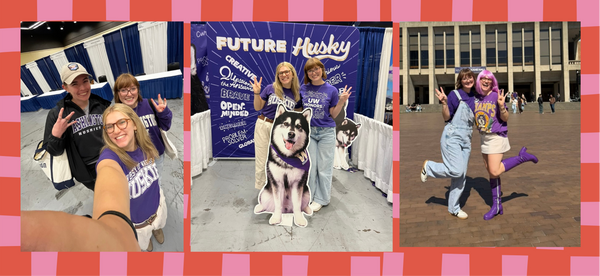
Other random tidbits where honors continued to stay relevant to me, despite it becoming less directly integrated into my world, included volunteering to staff an Honors table at the Seattle National College Fair, being on the Interdisciplinary Honors panel for Admitted Students Day, and being invited to be one of the student speakers at the Honors graduation celebration. All of these experiences share similar sentiment in marking both the ending of this journey for me and my participation as a gentle hand-off to new students. Through the process of reflection, I have learned to radically accept and recognize that many of the roles and positions I have held are insignificant, in the bigger picture, to me. They inevitably turnover each year and when I graduate soon, their vacancies will be filled. There is both grief when it comes to being done with this era, and there is gratitude, for I have given as much as I could have to a program and community that has given so much to me.
Honors courses I took this year:
-
HONORS 496: Integration of the Honors Core Curriculum
